Servers are the backbone of the internet. It’s also the backbone of modern businesses.
At Troinet, we provide low-cost, high-quality, and complete server management services for small business. Our server support includes outstanding server technician services, customer support, and powerful affordable hosting solutions for any business size.
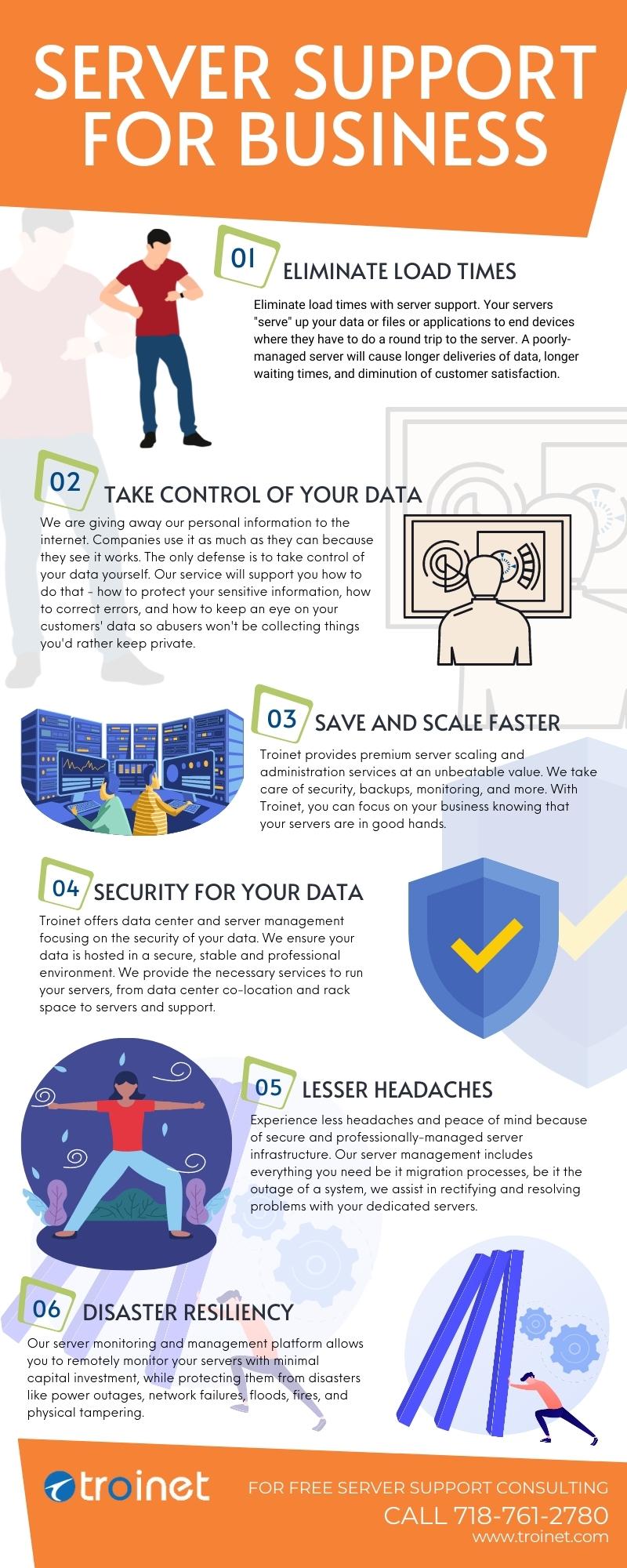
- Eliminate load times for local access
- Smooth flow of data for your staff
- Longer shelf life
- Take control of your own big data
- Flexibility to expand in the future
- Depend less on third-party hosting
Benefits of Server Support
A properly maintained server infrastructure provides tangible, measurable benefits that translate directly into improved business outcomes. These advantages extend beyond simple data storage to fundamentally reshape operational efficiency, security posture, and long-term scalability.
Enhancing Operational Productivity and Collaboration
One of the most immediate benefits of a dedicated server is the centralization of files and applications. A physical server acts as a central hub, providing a single, organized access point for employees to retrieve documents and use shared resources like printers. This centralization eliminates the issue of file sprawl, where data is scattered across individual computers, thereby reducing clutter and the risk of data loss.
Seamless Collaboration
This centralized architecture also provides the foundation for seamless collaboration and remote work. Servers support secure remote access through technologies such as Virtual Private Networks (VPNs), enabling employees to access shared files and applications from any location. This capability is critical for supporting modern, flexible work models, ensuring that teams can remain productive whether they are in the office or working remotely.
Run Data-Hunger Applications Smoothly and Efficiently
The performance gains are also substantial. Dedicated servers improve loading speeds for internal applications and websites, which minimizes wait times for employees and boosts overall productivity. For example, servers from manufacturers like HPE and Dell are equipped with powerful processors designed to run data-hungry applications smoothly and efficiently. This enhanced performance not only improves employee efficiency but also contributes to a better customer experience by ensuring swift online interactions.
Central Point for Robust Security Measures
A server infrastructure provides a central point for implementing and enforcing robust security measures. All network security protocols, including firewalls, antivirus software, and user authentication, can be managed from a single location. This centralized approach ensures that security is applied consistently across the entire network, providing a more robust defense against cyber threats. If a single computer becomes infected, the server can quickly identify and isolate the threat, preventing it from spreading to other devices.
Built-In Redundancy for Business Continuity
For additional protection, many servers are equipped with built-in redundancy, featuring redundant power supplies and hard drives. This redundancy ensures that the server can continue to function normally even if a component fails, creating a crucial safety net for business continuity. Centralized backups are essential for safeguarding vital business data against unforeseen events such as hardware failures, natural disasters, or cyberattacks
Servers Future-Proof Long-Term Expansion
The ability to scale is a determining factor in a business’s long-term success. Servers are generally designed with expandability in mind, allowing businesses to easily add storage and computing capacity as their needs evolve without requiring a complete system overhaul. This on-demand scalability is a key advantage, providing a cost-effective path for managing growth.
Common Challenges in Integrating Server Technology
Despite the clear benefits, medium-sized businesses face significant challenges in managing their IT infrastructure. These are not merely technical hurdles but are often self-perpetuating problems that pose existential risks to the organization.
Almost Half of Cyberattacks are Aimed at Small and Medium-Sized Businesses
Cyber threats are a top concern for business owners, with threats like ransomware, phishing, and malware being pervasive and highly destructive. A study by the U.S. Chamber of Commerce revealed that over half of small businesses consider these threats a major concern. A separate study by Accenture found that an estimated 43% of cyberattacks are aimed small and medium-sized businesses, yet only 14% feel they have adequate security controls in place to protect themselves.
Human Element is a Major Factor
The human element is a major vulnerability, as employee error is one of the biggest security risks. The consequences of a successful cyberattack are severe. Attacks can cripple operations, lead to the theft of sensitive data, and incur thousands of dollars in recovery costs. The financial impact of downtime is particularly staggering, with one estimate placing the following costs:
- $593 per minute
- 60% of small businesses are reported to close within six months of a cyberattack
Budget and Resource Constraints
IT is often perceived as a cost center and is usually skipped over in place of “budget constraints.”
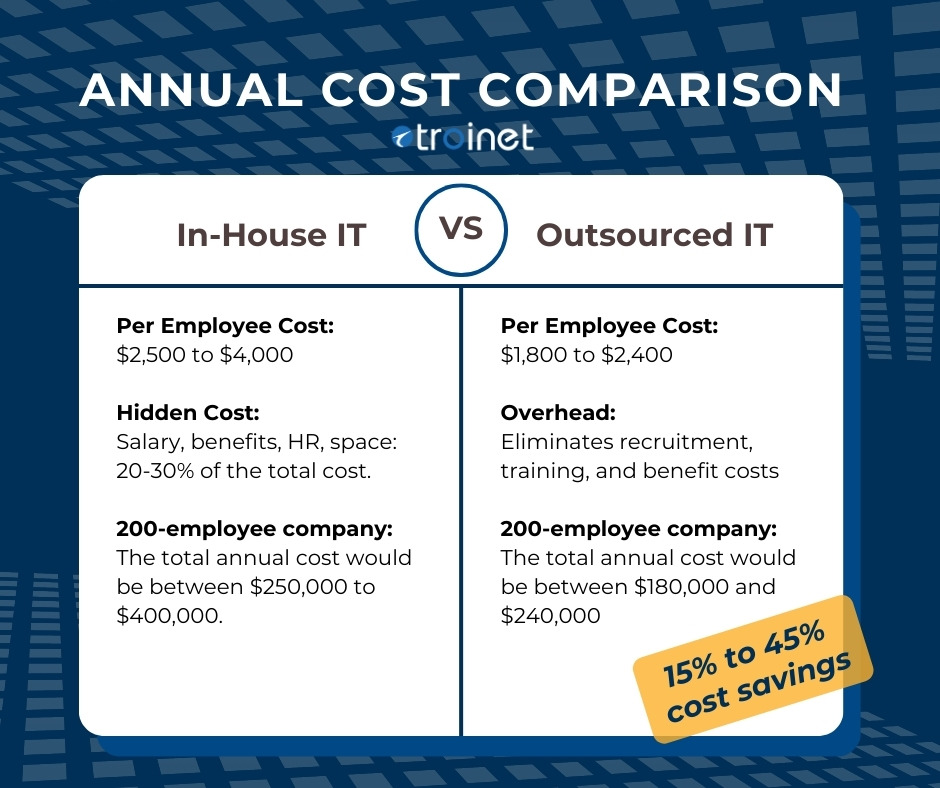
However, many businesses overlook the fact that hiring an in-house IT team can be prohibitively expensive.
The estimated annual cost for a single IT manager can range from $88,000 to over $120,000, including salary, benefits, and ongoing training. This substantial fixed cost puts immense pressure on a company’s operational budget.
Due to these financial and resource limitations, many businesses fall into a reactive “break-fix” model, addressing IT problems only after they have caused a major disruption. This approach, while seemingly cost-effective in the short term, is far more expensive in the long run than proactive, preventive maintenance.
Hardware or Software with “end-of-life” (EOL) or “end-of-support” (EOS)
Another common challenge is the reliance on legacy equipment and software that have reached their “end-of-life” (EOL) or “end-of-support” (EOS). The use of outdated technology not only slows down productivity and causes frequent compatibility issues and crashes but also presents a prime opportunity for cybercriminals to exploit security vulnerabilities that are no longer being patched by the manufacturer.
The Interconnectedness of the Issues and the Need for a Shift in Mindset
The biggest challenge is not any single issue, but the interconnected, self-reinforcing nature of these problems. It begins with budget constraints that prevent investments in new hardware or skilled personnel. This leads to the continued use of outdated and unpatched legacy systems, which in turn creates significant security vulnerabilities. A security breach or system failure, which is more likely to occur with outdated technology, then leads to crippling financial losses and reputational damage. The financial fallout from such an event further exacerbates the initial budget strain, trapping the business in a negative feedback loop. Breaking this cycle requires a fundamental shift from a reactive mindset to a strategic, proactive approach to IT investment.
The Role of Managed Service Providers (MSPs) as Strategic Partners in Server Management
In the face of these challenges, Managed Service Providers (MSPs) have emerged as a strategic solution, offering a new paradigm for IT management that provides a clear path out of the “break-fix” trap.
A Comprehensive Comparison: In-House vs. Outsourced IT
An in-house IT team offers complete control over IT strategy and operations, providing quicker response times for on-site issues and a deep familiarity with the organization’s culture and specific needs. However, this model comes with high fixed costs, including salaries, benefits, and ongoing training, and may lack the broad expertise required to manage complex modern IT environments.
By contrast, an MSP provides access to a wide range of expertise and specialists, offering 24/7 proactive monitoring and support at a predictable monthly cost.
This model is highly scalable, allowing a business to easily increase or decrease services as its needs change without the burden of hiring or laying off staff. However, it may result in less direct control and a reliance on a third-party vendor.

The primary duties of a Server Support technician include:
- monitoring systems for problems
- responding to alerts from monitoring software
- resolving system or network issues reported by users or administrators through various channels such as phone or email
- maintaining monitoring systems
- managing inventory of hardware and software on servers
- installing and updating software on servers
- backing up data from servers to a separate storage
- performing hardware upgrades on servers such as adding memory or replacing hard drives or power supplies
Server basic concepts
What servers are Why Not Just Use a Standard Personal Computer? How to choose a server for my business? What servers are
An IT server is a computer that is used to perform services either to other computers, customers, or employees. A server can store your files and “serve” them to your employees or customers. It can also perform computational tasks or run programs for your clients.
A server can also store important files such as your website/webpages, virtual PC’s, videos, photos, documents, which the company accesses. The server is usually called as the main server.
Why Not Just Use a Standard Personal Computer?
Unlike a personal consumer-grade or end-user computer, a server is designed to run and operate 24/7, 365 days a year, giving you unlimited accessibility anytime. The hardware inside the personal computer is not built to tolerate the heat generated by long-time operations.
If you store your important files in a PC, while the machine is running hot and multiple people can access it, the machine is going to crash. If that happens during working hours, no one is going to access anything which will cause your business to suffer.
You don’t want to buy a consumer-grade computer if your business runs with multiple people accessing files and data. You would need to buy a server-grade system, even if it is more expensive or would require a higher investment amount.
A server-grade hardware or system gives you the technologies that are capable to handle your business needs such as ECC or Error Correcting Code memory- a capability that corrects its owns errors in order for your operations to continue so the machine won’t shut down or fail during errors.
When one PC or end-user computer becomes corrupted or broken, a server gives you the confidence that your operations still continue because the files aren’t store in that PC, but are accessible via the server.
Your business does not deserve to “play with the odds” and think that the likelihood of “security breach or data storage failure won’t happen to me.” Your business deserves the right server system in place.
How to choose a server for my business?
Every business has different needs. We usually start with a FREE needs-based client analysis so we can provide a professional quotation of solutions.
The analysis may include the following questions:
- Cloud or in-house?
- What is the best choice to store my data?
- What are my business objectives and what server solution best fits for my needs?
- What server specifications do I need? What hardware do I need to buy?
If your business is located in New York or New Jersey, we can come, take a look, and assess your server needs.
We are physically located in Staten Island, New York, and have clients scattered across the vicinity. We sit down and help our clients throughout the process so you can enjoy the best solution.