
IT alignment is about ensuring that IT investments align with business goals and strategies.
IT alignment focuses not only on the issues surrounding the new technology but also on leadership, including working with the organization and gaining its support. It answers the following:
1. What are the key decisions to make?
2. Who are the key decision-makers?
3. How do they make these decisions?
Benefits of IT Alignment
Operational Benefits
Operational benefits are tangible and easy to estimate. These include streamlined processes, reduced redundancies, and increased productivity within the organization.
It also allows organizations to allocate IT resources more effectively, ensuring that IT investments are directed to initiatives that support business objectives.
Tactical Benefits
Tactical benefits are also tangible and are easy to estimate. If there is IT alignment, decision-makers have access to relevant data and insights, leading to more informed tactics or strategic decisions.
Strategic Benefits
Unlike the two above, these are intangible benefits. These benefits include strengthening the company’s brand and differentiating it in the market.
The Most Important Foundation for IT Alignment
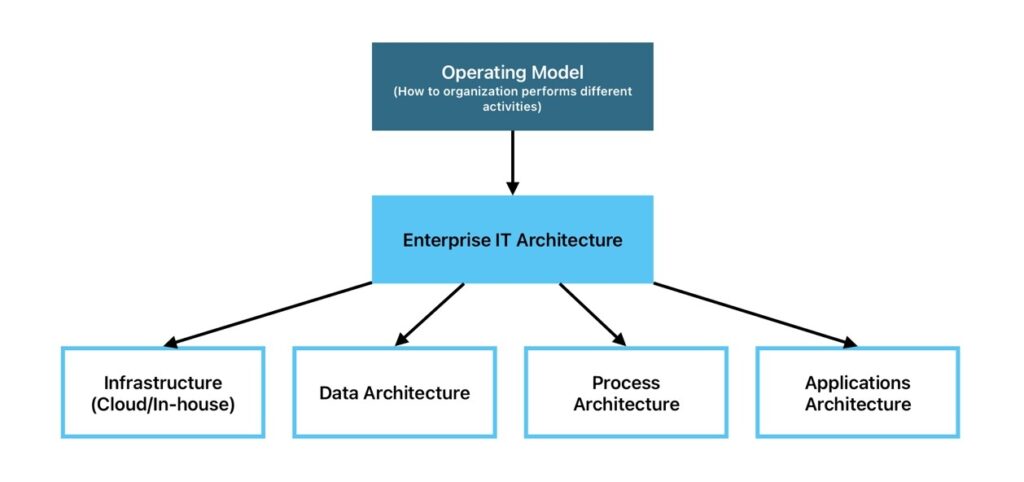
To execute IT alignment effectively, we start by determining the business’s Operating Model. It is the blueprint that defines how a company organizes its core processes and data to deliver value. It describes how the company executes that strategy day-to-day (e.g., “we use one central billing system for all units”)
It is the most critical input because it dictates the structure of the IT landscape. It instructs the enterprise architect on whether to build a single, centralized system or multiple, independent systems.
Drivers of IT Alignment
Here are factors that drive IT alignment:
IT Maturity
IT alignment involves determining the maturity of the IT infrastructure. IT maturity is the level of development and sophistication of an organization’s IT systems and processes.
Think of it like the stages of human growth. Just as a baby needs time, care, and the right environment to grow into a strong, fruitful tree, an organization’s IT systems also evolve from basic functionalities to advanced, integrated solutions.
For example, a company at an early stage of IT maturity might use only basic software for tasks such as accounting and email. As it matures, it may adopt more complex systems that integrate data across departments, enabling better decision-making and efficiency.
If IT maturity is accurately assessed, IT investments are better aligned, ensuring the business gets the most value from its technology.
What You “Currently Know”
Proper IT investments can be made by deciding based on what you currently know. Having what you already know allows you to determine the estimating method and the project estimate range.
For example, if the solution strategy is determined, we would use the top-down estimating method, craft a proposal, and provide a budget estimate with a -30% to +60% margin.
If what is determined are the deliverables, we would also perform the top-down estimating method, , craft a proposal and perform a budget estimate with -15% to +30% margins.
However, if what is determined are work packages, we would perform the bottom-up estimating method, craft a plan, and perform a budget estimate with a narrower range of -5% to +5%.
The Usage’s Lifecycle
IT alignment considers the lifecycle stage in which the IT service will be used.
For example, if the stage is the Acquisition and Procurement stage, the IT service needed is the development of bid specifications, such as hardware and software costs.
If the stage is Operations and Maintenance, the IT service should focus on IT staff provisions, space, furniture, and energy.
If the stage is End-of-Life, the IT service should focus on sanitizing storage media and managing physical shipping and delivery.
Risks of IT Projects
There are three common types of risks in developing IT projects: Development risk, organizational risk, and market risk.
Development Risks
Development risks ask, “Can the information system provider/developer develop the proposed system?” It factors in whether the provider has a strong Operational Model, including knowledge of the domain, processes, and system maturity, and whether they can implement the requirements on the available technical platform.
Organizational Risks
“Can the business adapt to the changes?” The provider must be able to list the specific IT requirements, the magnitude of the change, the business’s readiness to change, and gauge the top-level management’s willingness to support the change.
Market Risks
How likely is the competitor to imitate or implement the IT project first? What will be the level of customer/supplier acceptance? And what is the likelihood that superior technological alternatives will emerge in the market?